Where should your
next dollar go?
Set it. Let it run.
Everyone with real money has someone watching it. Tapedeck is that person, as software — it puts your dollars in the right order across debt, savings and retirement accounts, then manages what you invest to rules you set. No stock picking. No predictions. A flat fee, and a receipt for what it actually did.
Connect your accounts and Tapedeck does the work — every balance, rate and date read for you, and the whole plan built from them. No card, no credit check.
Both sides of the tape
Getting out of debt and getting invested are the same problem.
Everybody sells you one half. Budgeting apps stop at the debt. Robo-advisors start at the portfolio and assume you arrived debt-free with a full emergency fund. Your money doesn't work in halves, so neither does Tapedeck.
Before the market is even the right question
Arithmetic, not opinion. A 24.99% card is a guaranteed 24.99% return you can collect today.
- A payoff plan built from your real balances, rates and minimums — with the date each debt clears
- An emergency buffer sized to your job security, not to a rule of thumb
- Which account your next dollar belongs in — HSA, Roth, Traditional, 401(k), taxable
- What the wrong order is costing you, in dollars, over a stated number of years
Then a portfolio that mostly leaves you alone
Four decisions and no others. Roughly one to two rebalances a year.
- Rebalances when you've genuinely drifted — not on a calendar, not on a hunch
- Tracks every purchase separately, so it knows the tax consequence of each one
- Holds a sale that's sitting on a short-term gain until it qualifies for the lower rate
- Harvests deductible losses when markets provide them, without ever tripping a wash sale
Clear a debt and its payment doesn't become spending money — it flips straight to the next line. Auto-reverse. You're told, not asked.
The Order
Your money, as a running order.
This is the thing an advisor actually does for someone starting out, and the one question no robo-advisor will answer — because the honest answer often routes your next dollar into an employer 401(k) they can't charge you a percentage on. We charge a flat fee, so we can just tell you.
The actual screen — one person's numbers
The figures belong to an example person, and every one of them is computed from that person's inputs — as yours will be, in deterministic code, with no ranges, no “up to” and no estimates. The 7–8% and 4–5% thresholds are our stated policy rather than a result from a study, and the app says so where it uses them.
What it can do for you
One place, for the whole of it.
Debt, savings, retirement, taxes and the portfolio — answered by the same system, in the same order, with the same arithmetic.
Auto mode places the orders
Turn it on and Tapedeck buys and sells to your target itself — one symbol per side per day, every trade notified after the fact. Or leave it in Notify and it just hands you the list.
Every order clears eleven independent safety checks — order caps, daily-loss limits, drawdown and slippage breakers, and a duplicate-order ledger — before it reaches your broker.
A debt payoff schedule with dates on it
Balances, APRs and minimums in; a cascade out — which debt takes the extra dollars, what each one costs you while it lives, and the month it disappears.
Neutral, factual, no red icons and no “let's tackle this!” The screen states what it needs and moves on.
Retirement, in the right wrapper
Roth versus Traditional against your marginal rate. HSA if you qualify. 401(k) after the more efficient wrappers. A dollar in the wrong wrapper loses to tax for forty years.
No projected balance to age 65. That's a forecast we have no basis to make.
Your portfolio, to your rules
Keep exactly what you already own, take a diversified core, add your own names on top, or go fully custom. Tapedeck instruments whatever you choose and never tells you your portfolio is wrong.
Approvals are hashed and timestamped, so it can prove it never quietly changed what you picked.
Every purchase tracked separately
Not an average cost — each individual lot, with its own date and basis. That's what makes deferring a short-term gain, or harvesting a loss without tripping a wash sale, possible at all.
Wash sales run 30 days before a sale as well as after. Most tools quietly get this wrong.
An itemized bill for its own value
Quarterly: tax deferred and on which lots, the order it had you fund accounts in, rebalances executed, and the sales it talked you out of.
That last line is recorded as an event, never as a dollar credit. Putting a made-up number on it would make the receipt the exact thing it exists to replace.
The build, as it stands
This is the actual app.
Not renders. Screens from the iOS build, with one person's numbers running through them. The connections aren't live yet — see where it stands, below.
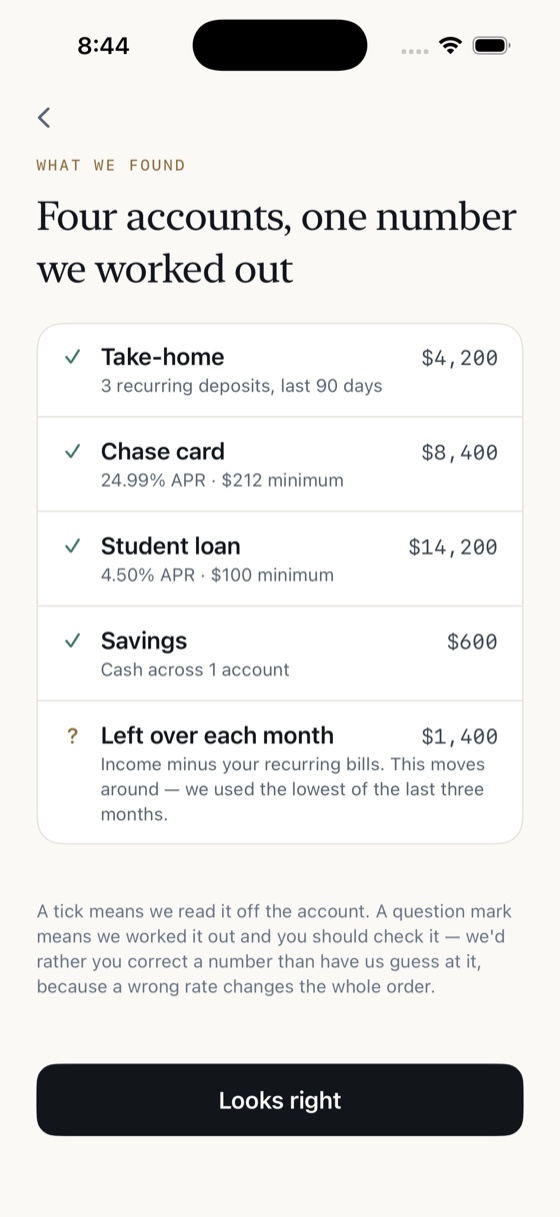
It marks what it knowsA tick means read straight off the account. A question mark means worked out, and worth your checking — a wrong rate reorders the whole plan.
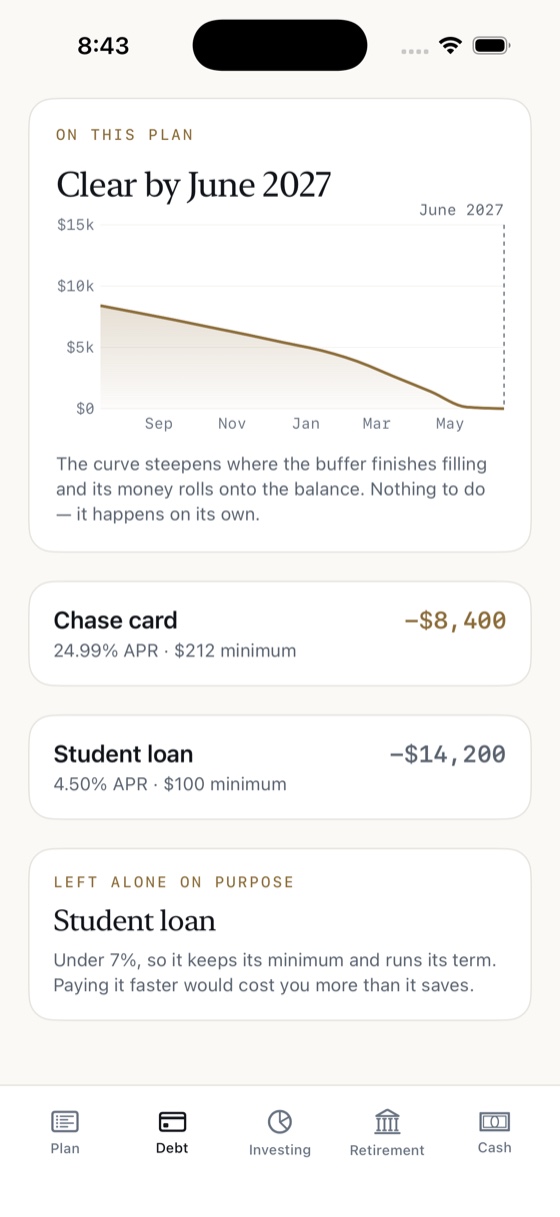
The payoff, with a date on itThe curve steepens where the buffer finishes filling and its money rolls onto the balance. Auto-reverse, on a chart.
You choose how much it doesNotify is the default deliberately. Auto trades for you and reports every fill afterwards — but only once you've watched it be right for a while.
Side B, in detail
Four decisions. Nothing else.
Most investing apps are built to give you something to do. Tapedeck is built to tell you when there is nothing to do — which, most months, is the truth.
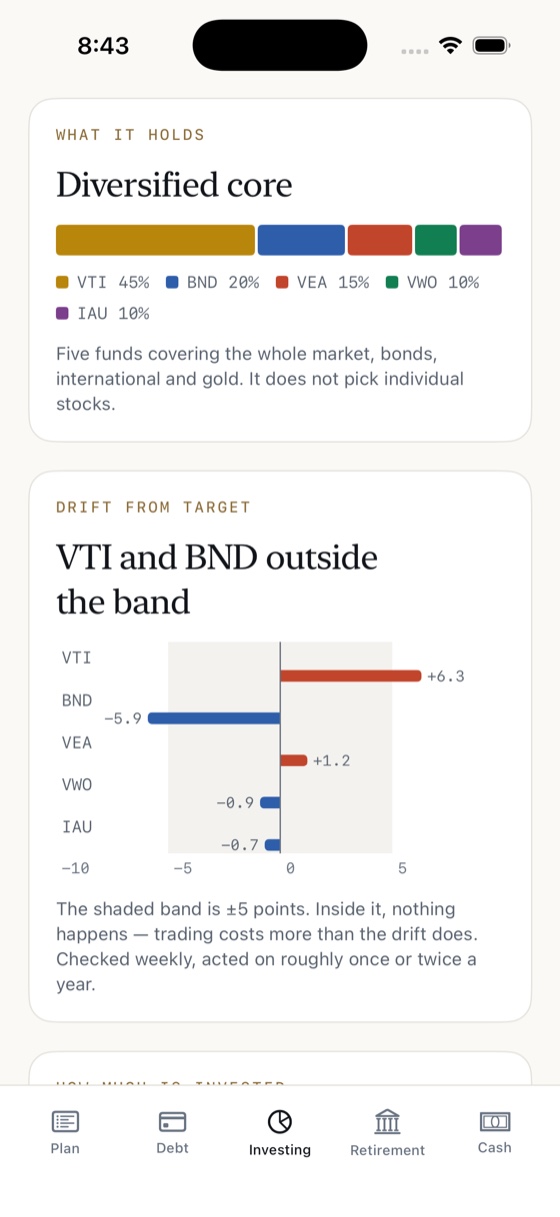
The shaded band on the right is ±5 points. Inside it, nothing happens, because trading costs more than the drift does. Two holdings are outside it here — that is what a rebalance looks like when there is finally a reason for one.
Rebalances when you've drifted
More than five points off your target, and only then. Acted on roughly once or twice a year.
Puts idle cash to work
Money sitting uninvested is a decision you didn't make on purpose.
Waits for the long-term rate
A sale sitting on a short-term gain waits for the lower rate unless drift is severe. Tracked to the day, per purchase.
Harvests losses you can deduct
Sells a losing lot, books the deduction, buys a replacement you approved — and never trips the wash-sale rule.
The part most apps leave out
We spent months looking for an edge. There isn't one.
Before building any of this we ran pre-registered trials — the hypothesis written down and time-stamped before the result, so we couldn't quietly move the goalposts afterwards. 166 trials across the whole research programme. 96 of them were attempts to find an edge in picking or timing. None of the 96 found one.
Everything below was tested honestly and did not survive:
So Tapedeck doesn't predict anything and doesn't claim to beat the market. What survived the testing was unglamorous and real: hold a sensible mix, keep costs down, don't trade for the sake of it, pay debt that costs more than the market returns, and take every deduction the tax code allows.
What this is, and what it is not
Harvesting a loss defers tax. It does not erase it. Selling a loser and buying a replacement lowers your cost basis, so the gain you eventually pay on is larger. What you gain is the time value of paying later, plus the gap between the rate a loss offsets today and the rate a future gain may pay.
It also needs gains to offset. Without them you're capped at $3,000 a year against ordinary income. The benefit is real, it's larger for higher brackets and larger portfolios, and it's smaller than most people selling it imply. We'd rather you heard that from us.
Choosing a risk level
Not “what return do you want.” What trough can you sit through?
No eight-question personality quiz producing a “Moderately Aggressive” badge. Risk is one dial — how much is invested versus held in short-term treasuries — and you set it against real drawdowns, not adjectives.
| Preset | Invested | Realised vol | CAGR | Max drawdown |
|---|---|---|---|---|
| Conservative | 68% | 9.8% | 6.33% | −28.7% |
| Balanced | 75% | 10.9% | 6.77% | −32.0% |
| Growth | 80% | 11.6% | 7.05% | −34.2% |
Measured over July 2007 to July 2026 — 19 years including 2008, 2020 and 2022. These are historical results from one sample and are not a forecast. A −32% trough happened inside that window and will happen again. Past performance does not indicate future results.
The week that actually matters
And when it drops 30%?
Investors reliably earn about a percentage point a year less than the very funds they hold — not from fees, but from selling at the wrong moment. That gap is bigger than fees and bigger than tax drag, and it's the one problem here that needs no forecasting ability to fix. It just needs something to be in the room.
Tapedeck's answer isn't reassurance. It's evidence about your own position — plus a 48-hour cooling-off period and a second confirmation on any change made during a drawdown. You can always override it. The friction is the product.
What it says
“Your plan hasn't changed. You're still on track to clear the Chase card in July 2027, and none of that depends on what the market did this week.”
Every clause in that sentence is checkable against your own accounts. Nothing in it is sentiment, and nothing in it is a prediction.
Most months, the right answer is nothing.
Tapedeck exists to tell you that clearly — and to handle the few times it's something else. No streaks. No confetti. No notification engineered to bring you back. A quiet month is the design working.
Where this actually stands
Since honesty is the whole pitch, here's the build status.
Tapedeck is pre-launch. You're joining an early-access list, not opening an account today. Everything on this page is either built, designed and specified, or waiting on a dependency — and this is which.
Early access
Press play on the boring version.
The one that doesn't promise to beat the market, doesn't want your attention every day, and shows you a receipt for exactly what it did. Get on the list and you'll be among the first accounts we open.
- Early access ahead of general availability
- The full research ledger — every trial, including the 96 that failed
- A say in what gets built next, while it's still cheap to change
- No card, no spam, one email at a time, unsubscribe in one click